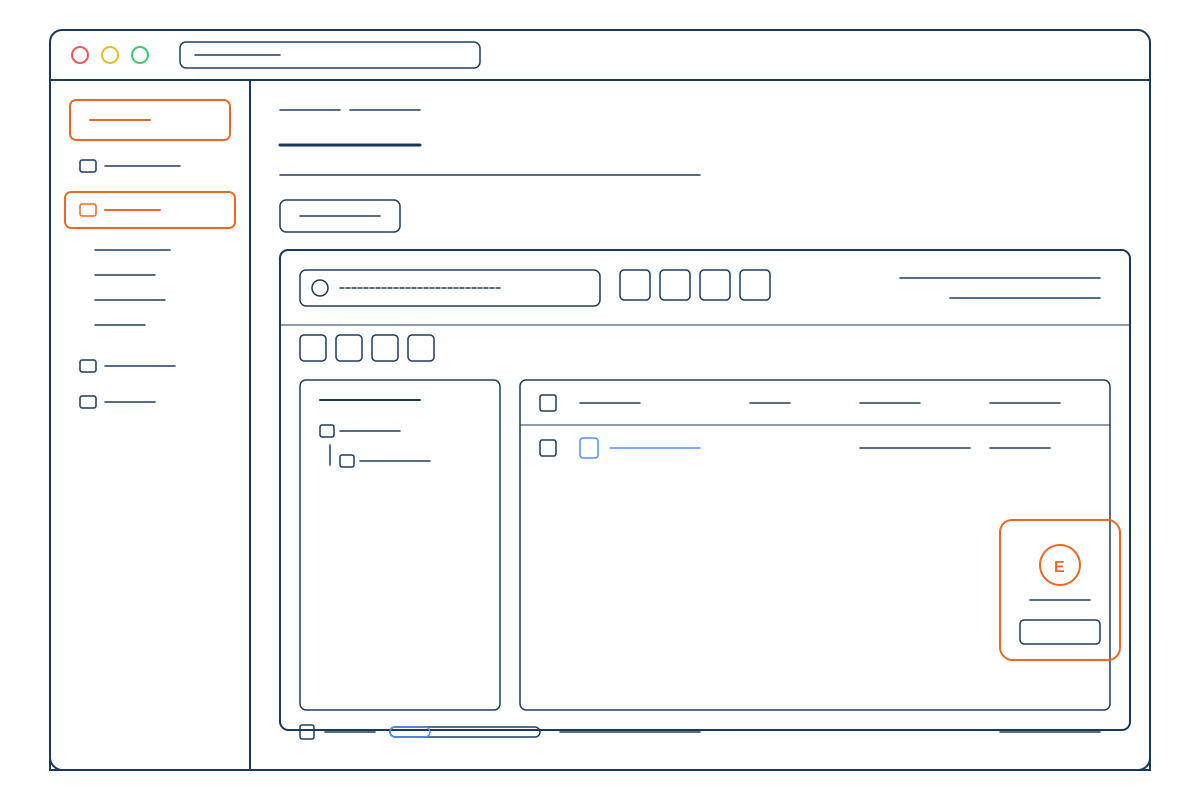
Short answer: add a category from the post editor (Sidebar > Categories > Add new category) or from the Posts > Categories screen in the WordPress admin. Assign categories to posts the same two ways. Categories apply to posts, not pages by default.
That covers 90% of what most people need. The rest of this guide covers the details: the difference between categories and tags (both are WordPress taxonomies, and which one you reach for depends on whether the dimension is hierarchical), how to use subcategories without creating a mess, how to clean up the “Uncategorized” default, what category archive pages are and how they look on your site, and why you cannot assign a category to a page (and what to do instead).
Two ways to add a category#
From the post editor#
The fastest way when you are writing:
- Open or create a post in the block editor.
- In the right-hand sidebar, click the Post tab (not Block).
- Expand the Categories panel.
- Click Add new category.
- Type the category name. Optionally pick a parent category if you want this to be a subcategory.
- Click Add new category to save.
The new category is created and assigned to this post in one step. It is also now available to assign to any other post.
From Posts > Categories#
Better when you are setting up the site structure before writing, or doing cleanup:
- In the WordPress admin, go to Posts > Categories.
- Fill in Name (what visitors see), Slug (the URL-friendly version – leave blank to auto-generate), Parent Category (optional), and Description (optional, some themes show this on the category archive page).
- Click Add New Category.
This screen also shows every existing category, the post count for each, and lets you edit or delete them.
The two methods create identical categories. Use whichever fits the moment.
Assigning a category to a post#
Every post must belong to at least one category. If you do not pick one, WordPress assigns the default category (usually “Uncategorized”) automatically. There is no “no category” option.
A single post can belong to multiple categories. Check as many as apply from the Categories panel in the post sidebar. This is legitimate – a post about Black Friday sales for a WooCommerce store might sit in both “Sales” and “WooCommerce tips.” Do not overdo it though: if a post is in five categories, none of them are really telling visitors what it is about.
To change the default category (so new posts without an explicit category do not all end up in “Uncategorized”), go to Settings > Writing > Default Post Category and pick a different one.
Can I assign a category to a page?#
No – not without a plugin or code. Categories and tags are attached to posts, not pages, in default WordPress. This is a conscious design choice, and it is the clearest practical difference between posts and pages: pages are standalone content (About, Contact, Services), posts are dated entries in a stream (articles, news, updates).
If you need categorized pages, your options are:
- Use posts instead. If the content is stream-like (articles, recipes, products), it belongs in posts, not pages. Assign categories normally.
- Use a custom post type. A CPT like “Services” or “Case Studies” can have its own taxonomies (categories and tags) separate from blog posts. This usually requires a plugin like Custom Post Type UI or theme support – how to create custom post types in WordPress walks through both routes and how to attach a custom taxonomy to the new type.
- Use a plugin. Some plugins add category support to pages directly, but this often creates more confusion than it solves and can break theme templates.
The simpler pattern: keep pages for your site structure (Home, About, Services, Contact) and use posts with categories for everything that benefits from grouping and archives.
Tags vs categories: which to use when#
Both are ways to classify posts, but they work differently:
| Categories | Tags | |
|---|---|---|
| Hierarchy | Yes – can have parent and child categories | No – flat |
| Purpose | Broad grouping of related content | Specific topics within posts |
| How many per post | 1-3 usually | 5-15 usually |
| Required? | Yes, at least one | No, optional |
| URL structure |
/category/news/
(or flat, depending on permalinks) |
/tag/wordpress/
|
| Think of them as | The sections of your site | The index at the back of a book |
A practical rule: if you only have a handful of them and they describe what the post is, they are categories. If you have dozens and they describe what the post mentions or covers, they are tags.
Example for a cooking blog:
- Categories: Breakfast, Lunch, Dinner, Desserts, Drinks. Every recipe belongs to one.
- Tags: gluten-free, vegan, 30-minute, slow-cooker, holiday, kid-friendly. Recipes get tagged with whichever apply.
Using both on the same post is normal. Using only categories is fine. Using only tags is unusual and usually means you should have made some of those tags into categories instead. For the SEO side – which archives to index, when to noindex tag pages, and how to clean up tag bloat – see WordPress tags and categories for SEO.
Subcategories#
A subcategory (or “child” category) sits under a parent. For example:
- Recipes
- Breakfast
- Lunch
- Dinner
- Desserts
To create a subcategory, pick a parent when creating the category. You can nest them multiple levels deep, but almost always you should not go beyond two levels. Three-level hierarchies become confusing for visitors and hard to maintain.
A post assigned to a subcategory is not automatically assigned to the parent. You have to check both if you want it to appear in both archive pages. Some themes handle this automatically, most do not.
Subcategories are useful when:
- A top-level category has a lot of posts that break into clear subgroups
- The subcategory is something visitors would navigate to directly
- The URL structure (
/recipes/breakfast/) makes sense to you
Subcategories are not useful as a way to create lots of granular tagging – that is what tags are for.
The "Uncategorized" problem and how to clean it up#
Every new WordPress install comes with a default category called “Uncategorized.” Posts published without a specific category assignment go there. If this has happened on your site, you have three steps:
1. Rename or replace Uncategorized#
You cannot delete the default category directly. But you can:
- Rename it. Go to Posts > Categories > Uncategorized > Edit and change the name and slug to something useful like “General” or whatever fits your content. This is the easiest fix.
- Replace it. Create a new category that should be the default, go to Settings > Writing > Default Post Category, and select the new one. Then delete Uncategorized.
2. Recategorize any posts stuck in Uncategorized#
From Posts > All Posts, filter by the Uncategorized category. Select the posts in bulk, choose Edit from the Bulk Actions dropdown, click Apply, then assign a proper category and uncheck Uncategorized. Click Update.
This recategorizes all selected posts in one action.
3. Check your permalinks#
If your permalink structure includes the category (like
/category/%category%/%postname%/
), any URL that used
/category/uncategorized/
is now broken. Either set up redirects, change your permalink structure, or accept the 404s if there was no external traffic to those URLs.
For cleanup like this, our WordPress database optimization guide covers the broader picture of cleaning up orphaned taxonomy data.
Category archive pages#
When you create a category, WordPress automatically creates an archive page at
yoursite.com/category/category-slug/
. This page lists all posts in that category, usually with excerpts and featured images. The layout comes from your theme’s
category.php
or
archive.php
template, and how much of each post shows up before a “Read more” link is controlled by the Read More tag inside each post (or by the theme’s excerpt logic, depending on which one the template calls).
What most themes show on a category archive:
- The category name as the page heading
- The category description (if you filled it in when creating the category)
- A list of posts in that category, newest first
- Pagination at the bottom
A few things to know:
- Category archives can rank in search. A well-organized category can become a landing page for a topic. Fill in the description, pick a good slug, and treat it like a page in its own right. Category slugs follow the same rules as post slugs – lowercase, short, hyphen-separated – and renaming one after the archive has traffic needs a 301 redirect from the old
/category/<slug>/URL. - You can change what appears there. Most page builders (Elementor Pro, Divi, Bricks) let you build custom category templates. The block editor’s Full Site Editing also supports custom category templates in block themes.
- The URL prefix can be changed. In Settings > Permalinks, you can change the “Category base” from the default
categoryto something shorter or remove it entirely with a plugin. Changing this after the site has traffic requires redirects – see our WordPress permalinks guide for how to handle structure changes without losing rankings.
Showing categories on the site#
Categories do not appear to visitors automatically. You choose where and how:
- In the post meta. Most themes display the category (or categories) under the post title or at the end of the post. This is usually automatic from the theme.
- In the navigation menu. You can add any category archive to your main menu. Go to Appearance > Menus, expand the Categories panel on the left, check the categories you want, and click Add to Menu. See how to add and manage menus in WordPress for the full menu setup.
- In widgets or blocks. The Categories widget (or the Categories block in the block editor) shows a list of all categories with post counts, usually in a sidebar or footer.
- On the homepage. If your homepage shows recent posts by default, those posts already display their categories. If you want a category-by-category layout, you need a page builder or a theme that supports it. How to set the homepage in WordPress covers the homepage options.
If you are also thinking about site structure more broadly, see how to change your WordPress site title and tagline for the other settings that shape how your site presents itself.
A quick category strategy#
Beyond the mechanics, a few principles that keep categories useful:
- Start with 5-10 categories, not 50. A site with 47 categories and 12 posts has no categories that mean anything.
- Each category should hold at least 3-5 posts. If a category only has one post, it is a tag.
- Category names should describe reader interest, not your internal taxonomy. “Tutorials” is better than “Content type: Instructional.”
- Do not nest more than two levels deep. Recipes > Breakfast is fine. Recipes > Breakfast > Pancakes > Sweet > Berry is not.
- Review categories periodically. Every six months or so, look at post counts per category. Merge underused ones, split oversized ones.
Categories done well make the site easier to navigate, better for SEO, and easier to maintain. Categories done badly make everything harder. The difference is almost always restraint – fewer, more meaningful categories beat a sprawling taxonomy every time.
If you are also setting up the rest of your content structure, how to add and embed videos in WordPress covers media embedding, and how to add and manage menus in WordPress covers navigation. If your site does not have a blog section yet, how to add a blog to a WordPress site is the companion to this article – categories only matter once you have posts to put in them. Together, these are the core of how visitors actually find content on your site.