Subdomains are how you add websites to your hosting account. Each subdomain is an independent virtual host with its own document root, PHP configuration, SSL certificate, and server settings. For example,
www.example.com
,
blog.example.com
, and
shop.example.com
are all separate subdomains.
Go to Hosting > Subdomains to get started.
Creating a subdomain#
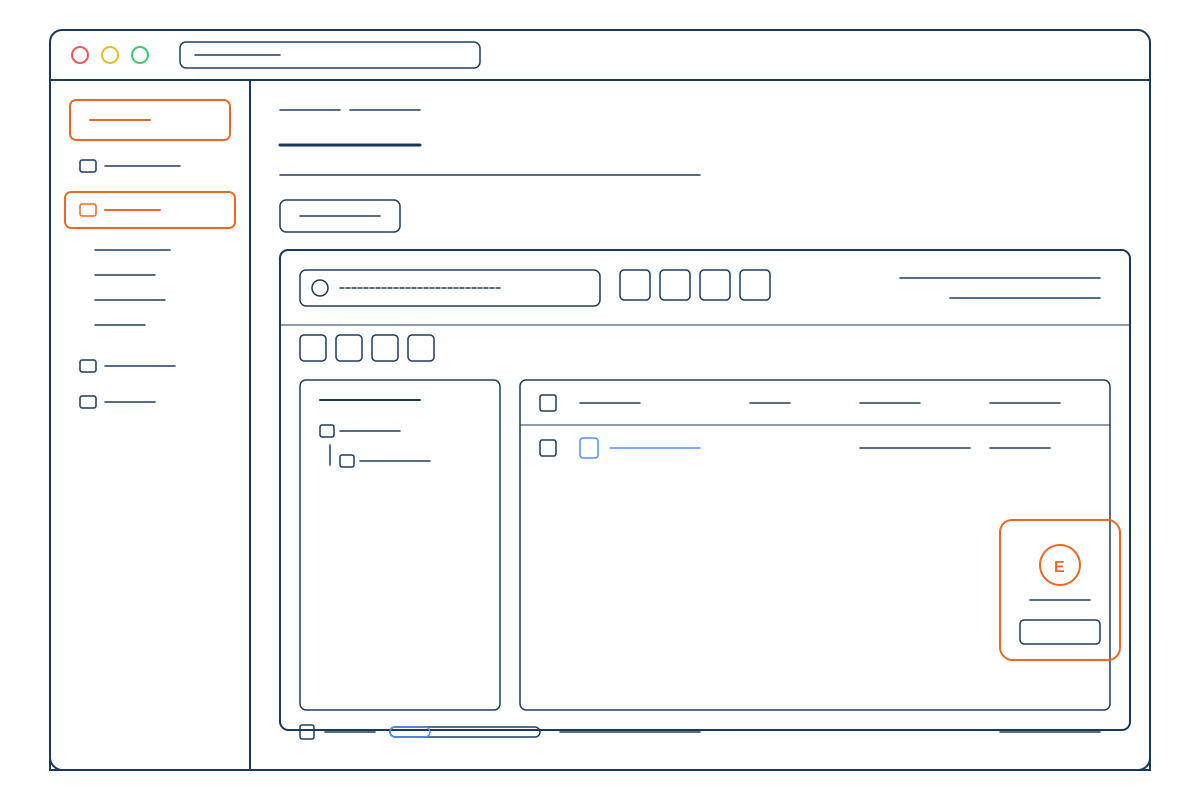
The form at the top of the page has two fields:
- Subdomain – Enter the hostname you want. Your domain name is appended automatically. For example, entering
wwwwith the domainexample.comcreateswww.example.com. This also sets up the non-www (apex) version of your domain automatically. - Home (optional) – The document root where your website files live. The base path
/home/youraccount/public_html/is shown as a prefix. Enter a subfolder (likeblogormy/app/public) or leave it blank to use the default path. You can click the folder explorer to browse existing directories.
Click Create subdomain to finish.
The helper panel on the right shows your server’s IP address. You’ll need this to create an A record in your DNS settings so your domain points to the correct server.
After creation, DNS propagation can take anywhere from a few minutes to 72 hours. Once DNS resolves, the server automatically provisions an SSL certificate for your subdomain.
Subdomain list#
The table shows all your subdomains with:
- Subdomain – The full domain name (with copy button that copies the https:// URL)
- Frontend – Either Apache or Nginx
- HUC URL – The Hostney User Content URL, an alternative hostname for accessing your site (with copy button)
The table is searchable and paginated at 5 items per page.
Subdomain settings#
Click the dropdown menu on any subdomain row for these options:
Change home#
Expands an inline form below the row where you can change the document root path. Enter the new relative path or leave it blank for the default. Click Update home to apply.
Not available if the subdomain has an active application deployment or WordPress installation. Disconnect or unregister those first.
Change frontend#
Opens a modal to switch between Apache and Nginx as the frontend web server. Nginx is the default and recommended for most websites. Apache is available if your application specifically requires it (e.g., for .htaccess support).
Not available if the subdomain has an active application deployment.
HUC URL#
The HUC (Hostney User Content) URL is an alternative hostname for your website, like
comparable-karita.hostney.app
. It’s useful for:
- Accessing your site before DNS is configured
- Testing changes without caching (HUC URLs bypass the cache)
- Sharing preview links
The HUC URL includes a robots.txt that blocks search engines, so it won’t interfere with your SEO.
Toggle the switch to enable or disable it. Enabled by default.
Cloudflare-only access#
When enabled, your website only accepts traffic that comes through Cloudflare’s proxy. Direct access to your server’s IP returns a 403 error. This adds an extra layer of protection since all traffic must pass through Cloudflare’s security and DDoS mitigation first.
Make sure your domain is proxied through Cloudflare (orange cloud enabled in Cloudflare’s DNS settings) before turning this on, or your website will become inaccessible.
PHP fallback routing#
Enable this if your application uses a front-controller pattern where all requests go through a single
index.php
file. Frameworks like Laravel, Symfony, and CodeIgniter work this way.
When enabled, requests to non-existent
.php
files are routed through
index.php
instead of returning a 404 error. When disabled, requesting a
.php
file that doesn’t exist returns a 404.
Only available for subdomains using the Nginx frontend.
Domain redirect#
Controls how the apex domain (example.com) and www subdomain (www.example.com) relate to each other. Three options:
- Redirect apex to www – Visitors to
example.comare 301 redirected towww.example.com. This is the default. - Redirect www to apex – Visitors to
www.example.comare 301 redirected toexample.com. - No redirect – Both versions serve content independently. Not recommended, as search engines may treat them as duplicate content.
This option is only available on apex (@) and www subdomains.
Delete#
Permanently removes the subdomain and all its associated configurations. Type DELETE to confirm. Files in the document root are also removed.
Not available if the subdomain has an active application deployment or WordPress installation.
DNS setup#
After creating a subdomain, point your domain’s DNS to your Hostney server:
- Go to your domain registrar’s DNS management.
- Create an A record for your subdomain pointing to the server IP shown in the helper panel.
- If you created a
wwwsubdomain, the apex domain is handled automatically. - Wait for DNS propagation (usually a few minutes, but can take up to 72 hours).
Once DNS resolves, Hostney automatically provisions an SSL certificate for your subdomain using Let’s Encrypt.
Things to know#
- All configuration changes take 1-2 minutes to apply after saving.
- Each subdomain gets its own SSL certificate, provisioned and renewed automatically.
- PHP version and other PHP settings are managed on the PHP page, not here.
- You can use the HUC URL to access your website immediately while waiting for DNS to propagate.
- Subdomains with active WordPress installations or application deployments have restricted settings. Unregister WordPress or disconnect the deployment before making changes to the home folder, frontend, or deleting the subdomain.